


 Testosterone Gel
 Avanafil
TRT Delivery Methods Explained
By Dr. James Carter, Men’s Health & Urology Specialist
Choosing the right TRT Delivery Methods is crucial for getting the best results from your testosterone replacement therapy. The delivery method you and your doctor select will influence how well your body absorbs testosterone, how stable your hormone levels remain, and how easily treatment fits into your everyday life.
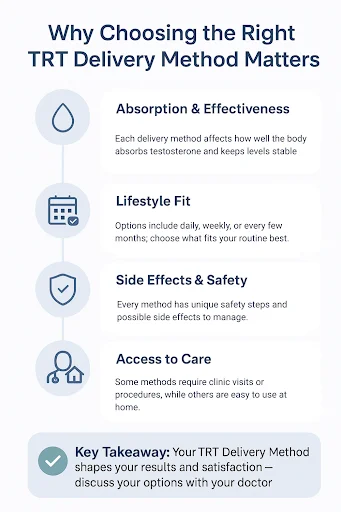
Why Delivery Method Choice Matters
When it comes to TRT Delivery Methods, one size does not fit all. Each man’s body responds differently to various delivery options.
Some methods may offer greater convenience or fewer side effects, while others provide more stable testosterone levels or better long-term results.
Key factors to consider include:
- Your age and overall health
- Your testosterone goals
- Your comfort with needles, patches, or gels
- How committed you are to daily routines
Access to healthcare providers for in-office procedures
Delivery Method Affects Consistency and Safety
Different TRT methods can produce different absorption patterns, routines, and side effect considerations. Gels may be convenient but require skin-transfer precautions. Injections may be less frequent but can create hormone peaks and troughs for some men. Patches may be simple but can irritate skin. Pellets may last longer but require an in-office procedure.
For example, someone who travels frequently might prefer longer-lasting pellets over daily gels. Others might want the flexibility to adjust dosing quickly, making injections or gels more practical.
Key Takeaway: Your delivery method isn’t just about preference — it can determine how effective your treatment is, how consistent your results are, and how satisfied you feel over time.
Gels
Testosterone gels are one of the most widely used TRT Delivery Methods, especially for men who want to avoid injections or surgery. Gels contain testosterone that is absorbed through the skin, delivering the hormone directly into the bloodstream.
You typically apply the gel once a day to clean, dry skin on your shoulders, upper arms, or abdomen. It’s important to let the gel dry fully before dressing and to wash your hands thoroughly afterward to avoid transferring testosterone to other people, especially women and children. For safety guidance, see the {[FDA guidelines for testosterone gel usage]https://www.fda.gov/drugs/information-consumers-and-patients-drugs/testosterone-products-questions-and-answers}
Advantages of Gels
Painless and non-invasive
Easy to use at home with no medical equipment
Provide steady testosterone levels when used consistently
Considerations
Requires daily commitment — missing applications can cause dips in hormone levels
Risk of skin-to-skin transfer, so you must follow safety steps carefully
Some men experience mild skin irritation or rashes at the application site
Key Takeaway: Gels are a convenient option for steady hormone levels if you can commit to a daily routine and handle application precautions.
Injections
Testosterone Replacement Therapy for Men
Testosterone injections are a proven TRT Delivery Method for men who prefer less frequent dosing. Injections deliver testosterone intramuscularly (deep into a muscle like the buttock or thigh) or subcutaneously (just beneath the skin).
Your injection schedule can vary from weekly to every few weeks, depending on the formulation. While injections can provide higher testosterone levels, they can also lead to hormone peaks and troughs — meaning you might feel fluctuations in mood, energy, or libido between doses. Studies on testosterone injection absorption rates support these variations and underscore the importance of consistent scheduling.
Advantages of Injections
Cost-effective compared to other methods
Fewer doses required over time
Direct delivery ensures high absorption
Considerations Discomfort or bruising at the injection site
Requires proper technique — some men self-inject at home after training, while others prefer a clinic visit
Peaks and drops in testosterone can affect mood and energy levels
Key Takeaway: Injections suit men who prefer infrequent dosing and don’t mind needles but should be carefully timed to minimize hormone swings.
Patches
Transdermal patches are a hands-off TRT Delivery Method that continuously deliver testosterone through your skin for about 24 hours. You simply apply a new patch each night, usually on your back, thighs, arms, or abdomen.
Patches provide stable testosterone levels when used correctly. However, some men experience skin irritation, redness, or itching at the site where the patch sticks. Studies like this {[transdermal testosterone patch effectiveness study]https://www.ncbi.nlm.nih.gov/pubmed/14583671} offer clinical insight into how well these patches maintain hormone stability and the frequency of skin-related side effects.
Advantages of Patches
Steady release keeps testosterone levels more consistent
Simple daily routine with no needles or gels
Low risk of accidental transfer to partners or family
Considerations
Must be worn for 24 hours and replaced daily
Visible patch may be noticeable under clothing
Skin reactions can be bothersome for sensitive skin
Key Takeaway: Patches are great for men who want a simple, once-daily method with steady hormone delivery — but be mindful of potential skin irritation.
Pellets
Implantable pellets are a long-acting TRT Delivery Method that provides months of steady testosterone without the need for daily or weekly applications. During a minor in-office procedure, your doctor inserts small pellets (each about the size of a grain of rice) under the skin, usually in your hip or buttocks. For a more detailed breakdown of the process, see this {[overview of pellet implantation procedure]https://www.urologyhealth.org/urologic-conditions/testosterone-replacement-therapy}.
These pellets slowly release testosterone over three to six months, which can keep hormone levels stable and reduce the hassle of frequent dosing. However, adjusting your dose requires another procedure, and there’s a small risk of pellet extrusion or site infection.
Advantages of Pellets
No daily or weekly dosing — lasts 3–6 months
Very steady testosterone levels over time
No risk of forgetting or skipping doses
Considerations
Requires a minor surgical procedure with local anesthesia
Possible risks include infection or pellets moving out of place
Not ideal for men who may need frequent dose adjustments
Key Takeaway: Pellets offer long-term, hassle-free testosterone delivery but require a minor procedure and are less flexible for dose changes.
Skin-Transfer Precaution for Gels
Testosterone gel can transfer to another person through skin contact if application instructions are not followed. Patients are usually advised to apply it only as directed, let it dry, cover the area when appropriate, and wash hands after use.
How to Choose
With so many TRT Delivery Methods available, how do you know which is best for you? This is where an open, informed conversation with your doctor is vital.
What to Discuss with Your Doctor
Ask your healthcare provider about:
- How your lifestyle might affect your choice (travel, work, daily habits)
- Your comfort with needles or minor procedures
- Any skin conditions that might make gels or patches difficult
- How steady you want your testosterone levels to be
- Insurance coverage and cost differences
For guidance on preparing for this conversation, check out this resource on {[how to talk to your doctor about TRT]https://www.mayoclinic.org/tests-procedures/testosterone-test/in-depth/testosterone-therapy/art-20045728} — it covers what to expect, what questions to ask, and how to align treatment with your goals.
Your doctor may also monitor your response to therapy through regular blood tests and symptom check-ins. Sometimes, switching methods is necessary to achieve the best balance of benefits and minimal side effects.
Key Takeaway: The best delivery method is the one that fits your life, your medical needs, and your personal comfort — all with your doctor’s expert input.
Explore Related Men’s Health Topics
Your guide to understanding testosterone replacement therapy from every major angle — meaning, symptoms, safety, timelines, treatment methods, and doctor conversations.
Testosterone Replacement Therapy Meaning
Testosterone Replacement Therapy for Men
Signs of Low Testosterone in Men
How Long Does TRT Take to Work?
TRT Delivery Methods Explained
Explore Related Men’s Health Topics
Low testosterone symptoms can overlap with sexual health, energy, mood, body composition, and broader men’s wellness concerns. These related MedsVista categories may help readers continue learning responsibly.
[Men’s Health Treatments general men’s wellness and treatment education
Testosterone Gel topical testosterone treatment education
Sildenafil erectile dysfunction medication education
Tadalafil longer-acting erectile dysfunction medication education
Levitra erectile dysfunction treatment education
Conclusion: Take Action
Your testosterone therapy success depends on more than just the medication — it depends on choosing the right TRT Delivery Method for your body and lifestyle.
Take the next step:
✔️ Talk with your healthcare provider about which option is best for you
✔️ Follow your treatment plan closely and adjust if needed
✔️ Order your testosterone therapy safely from a trusted source like MedsVista
Stay informed, stay safe, and take charge of your health — with MedsVista by your side.
Frequently Asked Questions
1: Which TRT delivery method is best?
There is no single best method. Gels, injections, patches, and pellets differ in routine, absorption, cost, comfort, and monitoring needs
2: Are injections stronger than gels?
Not necessarily. Both can be effective when prescribed and monitored correctly. The difference is often consistency, dosing schedule, absorption, and patient preference.
3: When should a man get tested for low testosterone?
Gels can transfer to others through skin contact if precautions are not followed. Patients should follow application and washing instructions carefully.
4: What are the drawbacks of injections?
Some men experience hormone peaks and troughs, injection discomfort, or scheduling challenges. Monitoring helps determine whether the method is working well.
5: Are pellets convenient?
Pellets can be convenient because they last longer, but they require an in-office procedure and are less flexible if dosage changes are needed.
6: Can a TRT method be changed later?
Yes. A healthcare provider may change the delivery method if side effects, convenience, absorption, or treatment response becomes a problem.
Questions That Help Narrow the Right Method
A healthcare provider may consider your schedule, comfort with injections, skin sensitivity, travel routine, fertility plans, cost, access to follow-up care, and response to treatment. The safest delivery method is the one that fits your medical needs and can be monitored consistently.