


 Testosterone Gel
 Avanafil

What Is Ivermectin Made Of?


During the COVID-19 pandemic, ivermectin became one of the most misunderstood drugs in the world. Social media often portrayed it as a miracle cure, while scientists repeatedly clarified its actual role as a powerful antiparasitic medication, not an antiviral. But what is ivermectin made of? and where does it come from?
This article explores ivermectin’s complex origins, detailed chemical structure, intricate manufacturing process, and its broad medical significance. Understanding these factors is essential not only for safe use but also for recognizing how this medication has reshaped global health strategies. All information provided aligns with guidance from the World Health Organization (WHO) and the Centers for Disease Control and Prevention (CDC).
Quick Answer — The Basics
Ivermectin is derived from natural compounds called avermectins, produced by a soil-dwelling bacterium known as Streptomyces avermitilis. Discovered in Japanese soil in the 1970s, this microbe generates a family of molecules with the extraordinary ability to disrupt parasitic nervous systems. These compounds are then chemically refined through a process called hydrogenation to form ivermectin — a semi-synthetic macrocyclic lactone. This class of large, ring-shaped molecules plays a vital role in enabling precise binding to parasite nerve and muscle receptors.
In lay terms, ivermectin blends the power of nature and the precision of chemistry. It starts as a natural substance and is improved in pharmaceutical labs to increase safety, bioavailability, and shelf life. This fusion of biology and chemistry has made ivermectin one of the most effective antiparasitic medications worldwide.
Fast Facts Table
Feature | Detail |
Origin | Soil microbe (Streptomyces avermitilis) |
Chemical Class | Macrocyclic lactone |
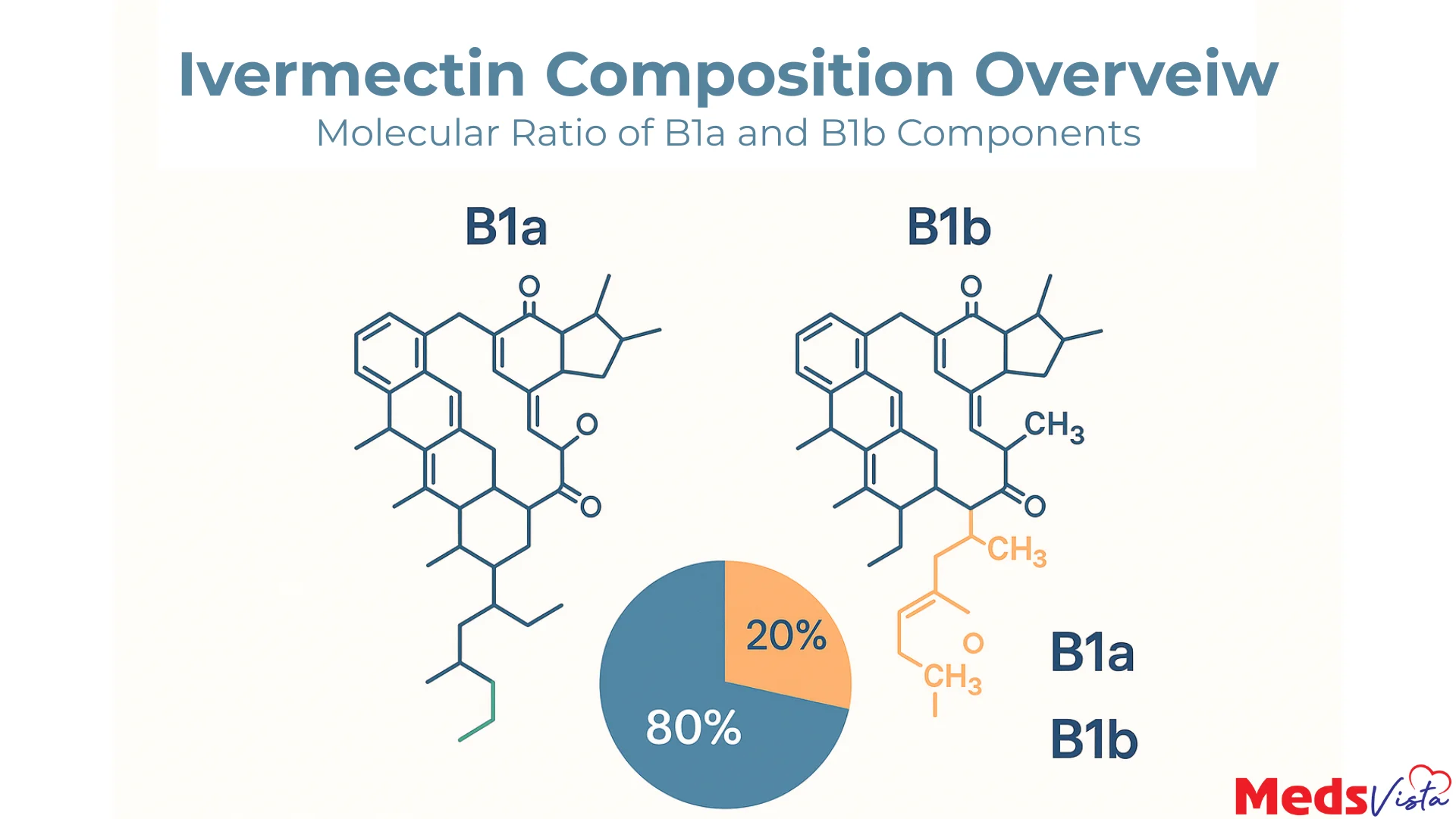
Active Components | Ivermectin B1a (80%) + B1b (20%) |
Type | Semi-synthetic antiparasitic |
CAS Number | 70288-86-7 |
Key Takeaways:
- Ivermectin originates from a naturally occurring soil bacterium.
- It is a semi-synthetic compound, combining organic and chemical refinement.
- Its potency comes from two core molecules: B1a and B1b, in a stable 80:20 ratio.
1. The Science Behind It — From Soil to Medicin
Step 1: Natural Discovery
In the early 1970s, Japanese microbiologist Satoshi Ōmura collected soil samples in a remote area of Japan. From one such sample, he isolated a previously unknown bacterium — Streptomyces avermitilis. His collaboration with American scientist William C. Campbell led to the identification of a group of novel compounds, which they named avermectins. These compounds showed strong antiparasitic activity during laboratory tests, especially against roundworms and arthropods.
This pivotal discovery led to the development of ivermectin, which was more stable and less toxic than its parent compounds. In recognition of their contributions, Ōmura and Campbell were awarded the 2015 Nobel Prize in Physiology or Medicine. Their work laid the foundation for one of the most important antiparasitic drugs ever developed.
Step 2: Refinement & Chemical Modification
The raw avermectins are not suitable for direct medical use. They undergo hydrogenation — a chemical reaction that saturates molecules with hydrogen atoms. This process changes the molecular bonds within the compound, making it more stable in the human body and reducing its toxicity.
Hydrogenation improves ivermectin’s pharmacokinetics, meaning it can be more easily absorbed, circulated, and metabolized in the body. It also allows for oral dosing, which is critical for use in remote regions where injectable medications are impractical.
Step 3: Formulation for Human & Veterinary Use
After hydrogenation, the refined ivermectin is formulated into several delivery systems, tailored to different patient needs:
- Tablets for treating intestinal parasites or systemic infections in humans.
- Topical creams or lotions for localized skin conditions like scabies or rosacea.
- Injectables or oral liquids for veterinary use, addressing parasites in livestock and pets.
These formulations also contain excipients — inactive ingredients such as microcrystalline cellulose (a stabilizer), magnesium stearate (a lubricant), and starch (an absorption enhancer). Topical solutions may also include preservatives and emulsifiers to enhance skin absorption and product longevity.
Key Takeaways:
- The natural discovery of avermectins revolutionized antiparasitic treatment.
- Chemical refinement boosts efficacy and safety.
- Ivermectin is available in multiple forms to serve both human and animal health needs.
2. Inside the Chemistry — Structure and Composition
The B1a/B1b Ratio
Ivermectin is not a single molecule but a carefully measured combination of two similar compounds: B1a and B1b. These are chemically related macrocyclic lactones, with minor variations in their side chains. B1a makes up 80% of the mixture, while B1b contributes 20%.
This ratio wasn’t randomly chosen — it was determined through rigorous testing in animal models. Researchers found that this blend maximized antiparasitic efficacy while minimizing side effects and improving metabolic stability. The combined pharmacokinetic behavior of the B1a and B1b components ensures prolonged activity in the body.
Why It’s Called a Macrocyclic Lactone
Macrocyclic lactones are named for their large, cyclic chemical structures containing a lactone ring — a type of ester. This unique arrangement allows ivermectin to selectively bind to chloride channels in the nerve and muscle cells of invertebrates. The macrocyclic ring helps the molecule penetrate parasite tissues and maintain its activity even in challenging biological environments.
How It Works (Mechanism of Action)
Ivermectin disrupts neural transmission in parasites by targeting glutamate-gated chloride channels. These channels, found only in invertebrates, regulate the movement of ions across nerve cell membranes. When ivermectin binds to these channels, it causes an uncontrolled influx of chloride ions.
This influx hyperpolarizes the cell membrane, effectively silencing the nerve signal. The result is paralysis and eventual death of the parasite. Since these specific channels are absent in humans and other mammals, the drug remains selectively toxic to parasites — a crucial factor for its wide safety margin.
Key Takeaways:
- Ivermectin is a dual-component drug with optimized ratios for performance.
- Its macrocyclic structure enhances target specificity.
- The drug paralyzes parasites by disrupting nerve signals — safely and effectively.
3. The Making of Ivermectin — Industrial Perspective
Fermentation & Extraction
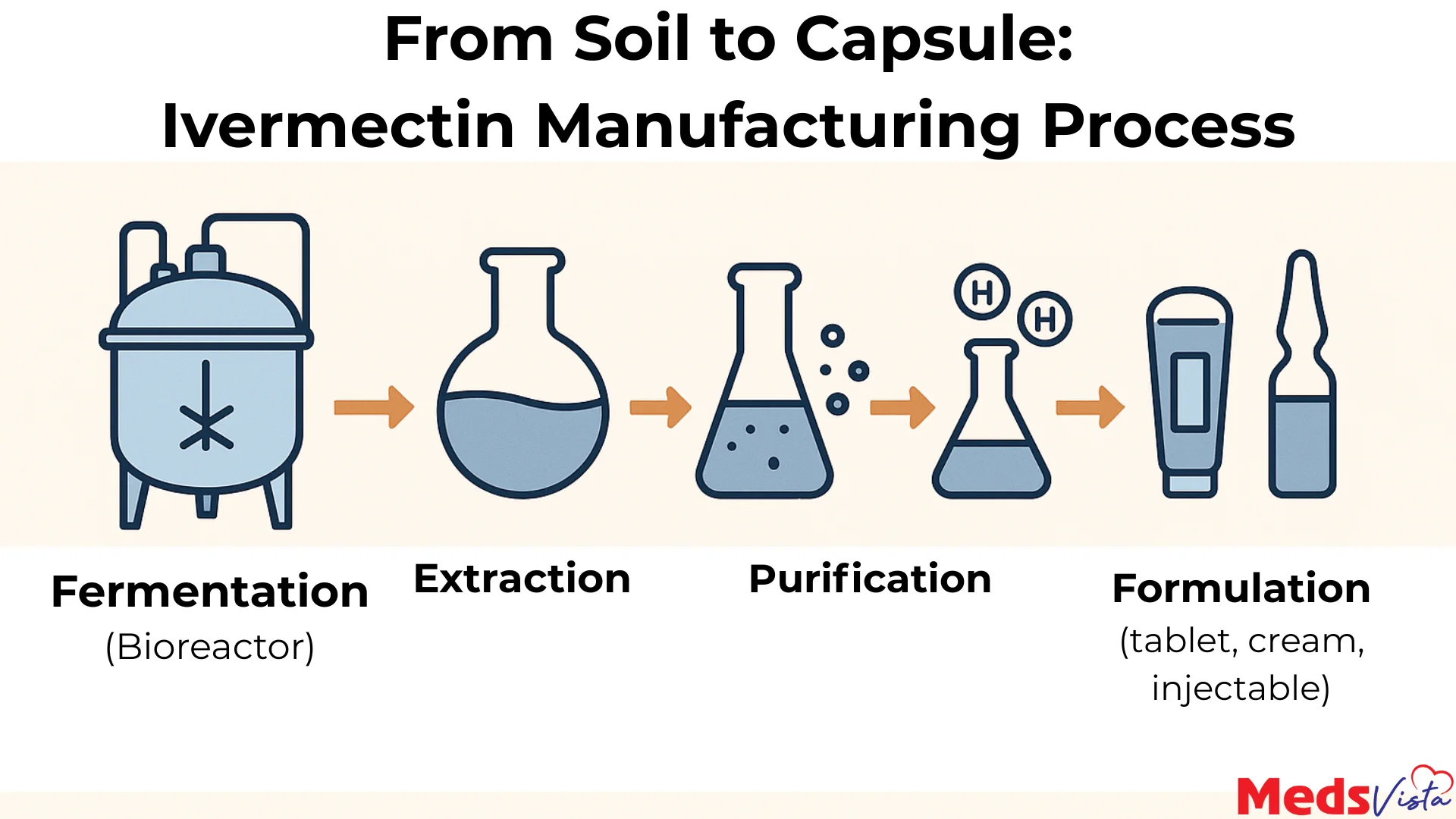
Commercial production of ivermectin starts with fermentation — a biotech process that cultivates Streptomyces avermitilis in controlled conditions. In large bioreactors, this bacterium grows in nutrient-rich media under precisely regulated temperature, pH, oxygen, and agitation.
After 7–10 days of fermentation, the culture broth contains crude avermectins, which are then filtered to separate the microbial cells. Organic solvents such as ethyl acetate are used to extract the active compounds from the liquid medium. The solution is concentrated, yielding a semi-purified avermectin mixture.
Purification & Quality Control
The next stage involves multiple purification techniques, including crystallization and chromatography. These steps remove impurities and isolate the specific B1a and B1b components. Hydrogenation is then applied to produce the final ivermectin product.
Each batch is subjected to rigorous quality testing under WHO-GMP standards. Key quality checks include:
- Purity: Should exceed 95%, verified through analytical techniques.
- Potency: Measured using high-performance liquid chromatography (HPLC) or biological assays.
- Stability: Assessed for shelf life, resistance to degradation, and environmental factors.
Active vs. Inactive Ingredients
Component | Role |
Ivermectin | Active antiparasitic agent |
Microcrystalline cellulose | Maintains tablet form |
Magnesium stearate | Prevents manufacturing friction |
Starch | Assists in breakdown and absorption |
Sodium benzoate, glycerin | Stabilizers in oral suspensions |
Key Takeaways:
- Fermentation is the first step in scalable ivermectin production.
- Chemical refinement ensures pharmaceutical purity.
- Every batch must meet stringent quality standards to guarantee safety and efficacy.
4. Safety, Global Uses & Regulatory Status
Approved Medical Uses
Ivermectin is recognized by global health agencies as a safe and effective treatment for numerous parasitic conditions, including:
- Onchocerciasis (river blindness): Caused by Onchocerca volvulus and prevalent in sub-Saharan Africa.
- Strongyloidiasis: A severe intestinal infection that can become fatal in immunocompromised individuals.
- Scabies and mite-related infections: Ivermectin is often used when topical treatments fail.
- Lymphatic filariasis: When combined with albendazole, it helps eliminate microfilariae from the bloodstream.
- Head lice and cutaneous larva migrans: Effective in select clinical cases.
The drug plays a central role in mass drug administration programs, where entire populations are treated periodically to curb endemic parasitic diseases.
Global Distribution & Impact
Since its development, over 3.7 billion doses of ivermectin have been administered worldwide. The WHO’s partnership with Merck’s Mectizan® Donation Program has drastically reduced river blindness, particularly in Africa. Its role in preventing blindness, disfigurement, and even death in millions of people has earned ivermectin the nickname “wonder drug” — within the boundaries of approved antiparasitic use.
Misuse & Misinformation Warning
During the COVID-19 pandemic, ivermectin gained false prominence as a supposed antiviral. However, research has consistently shown it lacks efficacy against viruses like SARS-CoV-2. The FDA’s ivermectin safety notice stresses the dangers of consuming veterinary formulations or self-dosing based on misinformation.
Regulatory Status
- WHO: Listed as an Essential Medicine.
- FDA: Approved for specific human and animal parasitic infections.
- EMA: Authorized in several EU countries.
Key Takeaways:
- Ivermectin has revolutionized treatment of parasitic diseases globally.
- Public health programs rely on it for disease elimination.
- Misuse poses significant health risks.
FAQs
Q1: Is ivermectin natural or synthetic?
It’s semi-synthetic — derived from natural sources but chemically refined for safety and effectiveness
Q2: What bacteria produces ivermectin?
Streptomyces avermitilis, found in Japanese soil.
Q3: What is ivermectin’s chemical formula?
C48H74O14 (B1a) and C47H72O14 (B1b).
Q4: Are there different grades of ivermectin?
Yes. Only pharmaceutical-grade formulations are approved for human use. Veterinary versions are not safe for humans.
Q5: Can I make ivermectin at home?
Absolutely not. It requires complex biotech facilities, precision instruments, and strict quality controls.
Q6: How does ivermectin differ from other antiparasitics?
It targets glutamate-gated chloride channels — a unique mechanism compared to drugs that attack metabolism or reproduction.
Q7: Is ivermectin WHO-GMP certified?
WHO doesn’t certify drugs but mandates production under GMP (Good Manufacturing Practices), which most approved manufacturers follow.
Bottom Line — From Microbes to Modern Medicine
Ivermectin exemplifies the synergy between nature and science. From the discovery of a soil microbe to its transformation into a life-saving drug, its journey is a testament to scientific ingenuity. Used correctly, it protects millions against debilitating parasitic infections and remains indispensable in global health.
To ensure safety and efficacy, always use pharmaceutical-grade products and rely on medical professionals for guidance. At MedsVista, we are committed to offering trusted options for your treatment needs.
